
02 · Fillers
Hyaluronic acid fillers: volume, folds and facial contour
Hyaluronic acid filler treatment is the application of a hyaluronic acid gel, a substance naturally present in the skin, at specific points of the face to restore lost volume, soften folds and define contours. The result is immediate, lasts on average 12 to 18 months and can be reversed with an enzyme, hyaluronidase, if needed. At Yamagata Dermatologia, in Ipanema, Rio de Janeiro, it is performed by dermatologists after a medical evaluation.
- Duration
- About 1 hour
- Anesthesia
- Numbing cream and anesthetic in the gel itself
- Result
- Immediate
- How long it lasts
- On average, 12 to 18 months
How it works
With aging, the face loses volume: the facial bones are reabsorbed, the fat compartments shrink and shift, and the skin loses support. The result is deeper folds, hollow under-eyes and loss of contour definition.
The hyaluronic acid used in fillers is a laboratory-made gel, similar to the one naturally present in the skin. Applied in specific planes and points, it restores lost volume and gives support back to the tissues. There are gels of different consistencies: firmer ones are used where projection is needed, such as the chin and jawline, and softer ones in areas of thin skin, such as the under-eyes and lips.
Because the plan is made by region and by amount of product (in milliliters), the treatment is individualized for each face.
Indications
- Volume loss and foldsNasolabial folds, temples, cheeks and marionette lines.
- Facial contour and double chinDefinition of the jawline and chin.
- Dark circlesHollow under-eyes (tear trough).
- LipsLip contour, volume and hydration.
- NoseCorrection of nose irregularities, without surgery.
Treated areas
Upper faceTemples · Eyebrows
MidfaceCheeks (malar area) · Under-eyes (tear trough) · Nasolabial folds · Nose
Lower faceLips · Marionette lines · Chin · Jawline
What a session is like
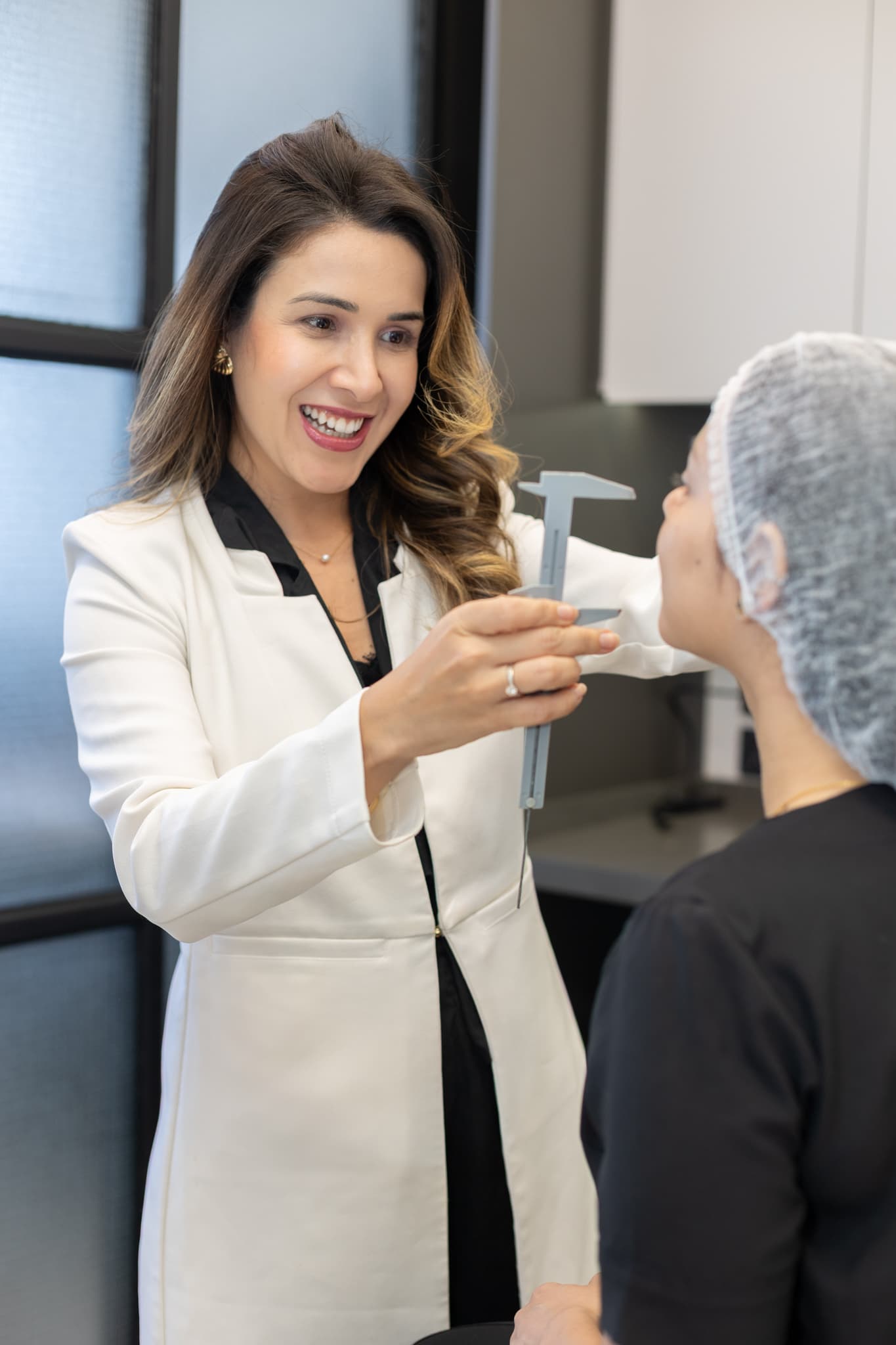
The doctor assesses the face at rest and in motion, analyzes its proportions and marks the injection areas. After the skin is cleaned and a numbing cream is applied, the gel is injected with a fine needle or a cannula (a blunt-tipped needle that reduces the risk of bruising). Most fillers contain anesthetic in their formula, which makes the application more comfortable.
Recovery
You can return to your activities on the same day. Swelling, tenderness and small bruises are common in the first few days.
Sessions and results
The result is visible right after the application and settles over the following weeks, as the swelling goes down. The number of sessions and the interval between them depend on the dermatologist's individual evaluation and on each patient's clinical concern. The average duration is 12 to 18 months and varies from person to person.
Contraindications
Fillers are not recommended during pregnancy and breastfeeding, over infections, herpes or active inflammation in the area, or for people allergic to the product's components. Active autoimmune diseases, use of anticoagulants and previous permanent fillers in the area require evaluation; in these cases, dermatologic ultrasound can help locate products already applied.
At the evaluation, the dermatologist reviews your health history, current medications and previous procedures to confirm the indication.
All procedures are recommended and performed after an individual medical evaluation. Results vary from person to person.
Questions
Frequently asked questions
Do fillers make the face look artificial?
No, when the plan respects the anatomy and proportions of each face. The amount of product and the injection points are defined at the evaluation, focused on restoring what was lost with aging rather than changing the features.
How long do hyaluronic acid fillers last?
On average, 12 to 18 months. Duration varies according to the product, the treated area and each person's metabolism. Areas with more movement, such as the lips, tend to absorb the product faster.
Can fillers be reversed?
Yes. Hyaluronic acid can be dissolved with hyaluronidase, an enzyme applied to the area, which allows excess or irregularities to be corrected.
What is the difference between fillers and biostimulators?
Hyaluronic acid fillers restore volume immediately, at the point where they are applied. Biostimulators stimulate the body to produce collagen, with a gradual gain in firmness and skin quality. The two can be combined.
Will I bruise after fillers?
You might. Small bruises and swelling are common in the first few days, especially on the lips and under the eyes, and disappear within a few days. Using cannulas in some areas helps reduce them.
Team
Medical team
See also
Related treatments
Fillers
Lip filler
Learn moreFillers
Non-surgical nose reshaping
Learn moreFillers
Chin filler
Learn moreFillers
Hyaluronidase
Learn moreBiostimulators and biorevitalization
Collagen biostimulators
Gradual gain in firmness and support.
Learn moreBiostimulators and biorevitalization
Harmonyca (hyaluronic acid and calcium hydroxylapatite)
Hyaluronic acid and calcium hydroxylapatite for support and volume.
Learn more