05 · Lasers and light
Erbium laser: skin resurfacing, scars, stretch marks and fine wrinkles
The erbium laser acts on the water in the skin and removes microscopic layers of the surface in a controlled way, stimulating skin renewal and collagen production. It is indicated to improve texture, fine wrinkles, acne scars and stretch marks and to treat lesions such as xanthelasma and sebaceous hyperplasia. At Yamagata Dermatologia, in Ipanema, Rio de Janeiro, it is performed by dermatologists after a medical evaluation.
- Duration
- About 1 hour
- Anesthesia
- Numbing cream
- Recovery
- Redness and peeling for a few days
- Result
- Progressive, over months
How it works
The erbium laser emits a wavelength that is strongly absorbed by the water in skin cells. When it reaches the skin, the energy vaporizes microscopic layers of the surface precisely, with little heat spreading to the neighboring tissues.
In fractional mode, the laser treats the skin in microscopic columns, with small islands of intact skin between them, which speeds up recovery. The skin responds by renewing its superficial layers and producing collagen, which improves texture, fine wrinkles, scars and stretch marks.
The same laser, with other settings, is used to remove superficial lesions such as xanthelasma and sebaceous hyperplasia.
Indications
- Dull skin, texture and poresUneven texture, pores and dull skin.
- Wrinkles and expression linesFine wrinkles, including around the eyes and mouth.
- Acne scarsDepressed scars and skin irregularities.
- Stretch marksWhite and red stretch marks.
- Eyelids and tired lookThin skin with lines on the eyelids.
Treated areas
Face and neckFace · Eyelids · Perioral area (around the mouth) · Neck · Décolletage
BodyArms · Abdomen · Flanks
Lesions and marksStretch marks · Scars · Xanthelasma (yellowish plaques on the eyelids) · Sebaceous hyperplasia (small yellowish bumps on the face)
What a session is like
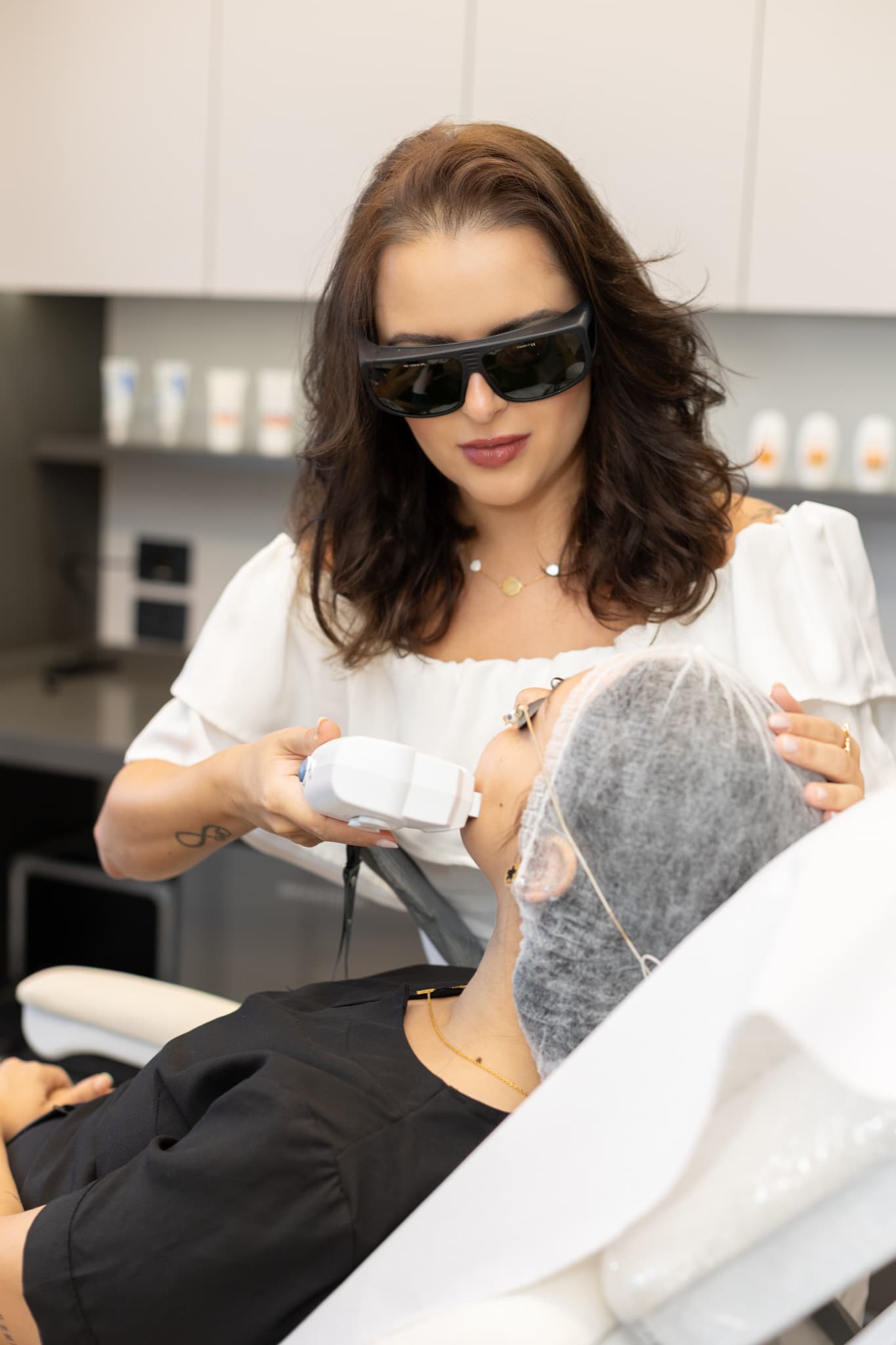
After the skin is cleaned, a numbing cream is applied. The patient and team wear protective glasses. The doctor passes the handpiece over the area with the settings defined at the evaluation. The sensation is of heat and slight pricks. A session lasts about 1 hour.
Recovery
Right after the session, the skin is red and warm, as after sun exposure. Over the following days, small crusts or fine peeling form and come off within three to seven days, depending on the intensity of the treatment.
Sessions and results
The number of sessions and the interval between them depend on the dermatologist's individual evaluation and on each patient's clinical concern. The improvement in texture is noticed after peeling, and the effect on wrinkles, scars and stretch marks develops over the months, with collagen production. The response varies from person to person.
Contraindications
The erbium laser is not recommended during pregnancy, over tanned skin, wounds, infections or active herpes, or for people prone to keloids or with diseases that cause light sensitivity. Recent use of isotretinoin and darker skin require careful evaluation.
At the evaluation, the dermatologist reviews your health history, current medications and previous procedures to confirm the indication.
All procedures are recommended and performed after an individual medical evaluation. Results vary from person to person.
Questions
Frequently asked questions
Does the erbium laser make the skin peel?
Yes. After the session, the skin is red and forms small crusts or fine peeling, which come off within a few days. How much it peels depends on the settings used.
Does the erbium laser treat acne scars?
Yes. Fractional erbium laser renews the skin surface and stimulates collagen, which softens depressed scars. Deep scars usually require a combination with other treatments, such as subcision and microneedling.
How long until I can return to my activities?
It depends on the intensity of the treatment. In general, redness and peeling last three to seven days, during which sun exposure should be avoided. Activities without sun exposure can be resumed right after the session.
What is the best time of year to have it?
The months with less sun exposure are preferred, because treated skin is more sensitive to the sun. With strict sun protection, the treatment can be done at other times, depending on the evaluation.
Team
Medical team
See also
Related treatments
Lasers and light
Etherea®
Learn moreLasers and light
Acroma® laser
Learn moreLasers and light
Intense pulsed light
Learn moreNon-surgical skin tightening and contouring
Evolla® XL
Microneedling radiofrequency that stimulates collagen.
Learn moreMicroneedling, MMP and peels
Microneedling
Learn moreMicroneedling, MMP and peels
Chemical peel
Learn more