
04 · Non-surgical skin tightening and contouring
PDO threads: smooth and lifting threads for skin support
PDO (polydioxanone) threads are absorbable threads placed under the skin with fine needles or cannulas, without incisions. Smooth threads form a mesh that stimulates collagen production and improves skin firmness and quality; lifting threads have small barbs that reposition and support the tissues. Over time, the body absorbs the threads, and the collagen formed around them remains. At Yamagata Dermatologia, in Ipanema, Rio de Janeiro, the procedure is performed by dermatologists after a medical evaluation.
- Anesthesia
- Local, at the entry points
- Duration
- About 1 hour
- Recovery
- Swelling and bruising for a few days
- Thread absorption
- About 6 months
How it works
Polydioxanone (PDO) is the same material that has been used for decades in absorbable surgical sutures. Placed under the skin, the thread triggers a mild, controlled inflammatory reaction that stimulates collagen production around it. Over about six months, the body absorbs the thread, and the collagen formed remains.
The PDO threads used at the clinic are of two types:
- Smooth threads: thin, without barbs, placed in large numbers to form a mesh under the skin. They do not pull the tissues; the effect comes from collagen stimulation, which improves firmness, thickness and fine lines.
- Lifting threads: thicker, with small barbs along the thread that anchor to the tissues. Once inserted, they are adjusted to reposition and support areas such as the cheeks and jawline.
Indications
PDO threads are indicated for mild to moderate laxity and to improve skin quality, for people who want support without surgery. In cases of marked laxity with a large excess of skin, plastic surgery tends to be more appropriate.
- Facial skin laxityMild to moderate sagging of the cheeks and midface.
- Facial contour and double chinLoss of jawline definition and a sagging double chin.
- Volume loss and foldsNasolabial folds deepened by laxity.
- Wrinkles and expression linesFine lines of the glabella, eyelids and around the mouth.
Treated areas
Lifting threadsUpper face (forehead and eyebrows) · Midface (cheeks) · Jawline · Full face
Smooth threadsEyelids · Glabella (between the eyebrows) · Smoker's lines (above the lip) · Cheeks · Nasolabial folds · Double chin
What a session is like
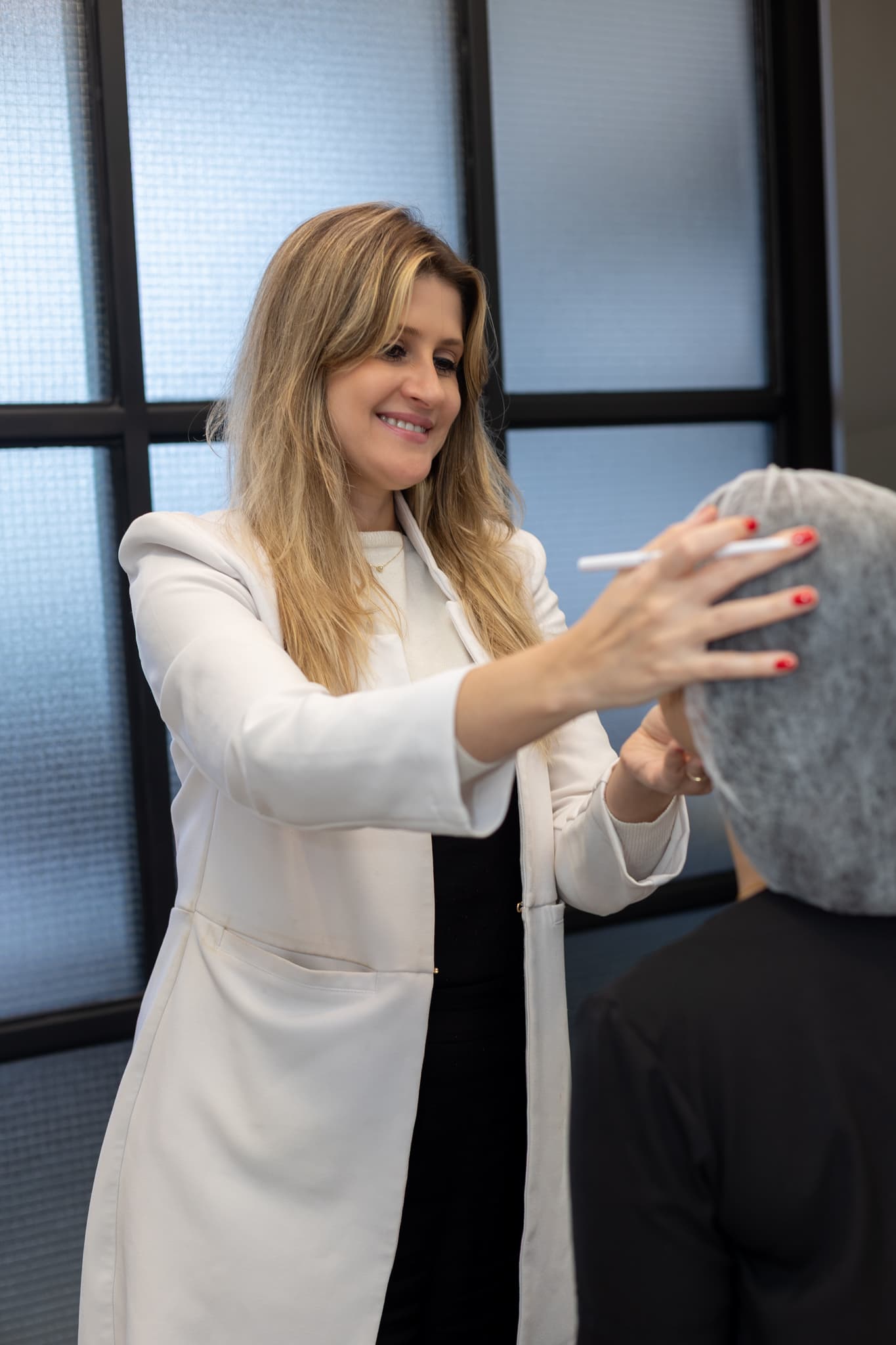
The doctor marks the entry points and the path of each thread on the skin, according to the plan made at the appointment. After cleaning the skin and applying local anesthesia at the entry points, the threads are inserted with fine needles or cannulas. Lifting threads are adjusted at the end, and the excess ends are cut. No stitches are needed.
Recovery
In the first few days, swelling, small bruises at the entry points and tenderness are common, and, with lifting threads, a pulling sensation or small skin irregularities, which settle within one to two weeks.
Sessions and results
The number of sessions and the interval between them depend on the dermatologist's individual evaluation and on each patient's clinical concern. With lifting threads, some support is noticed right after the procedure; with smooth threads, the improvement is gradual, over two to three months, as collagen is produced. The effect usually lasts 12 to 18 months and varies from person to person.
Contraindications
PDO threads are not recommended during pregnancy and breastfeeding, over infections or active skin inflammation, for people prone to keloids, or in cases of very marked laxity. Active autoimmune diseases, bleeding disorders, use of anticoagulants and permanent fillers in the area require case-by-case evaluation.
At the evaluation, the dermatologist reviews your health history, current medications and previous procedures to confirm the indication.
All procedures are recommended and performed after an individual medical evaluation. Results vary from person to person.
Questions
Frequently asked questions
Do PDO threads hurt?
The procedure is done with local anesthesia at the entry points, and most people feel only pressure and mild discomfort. In the first few days, the area may be tender to the touch, especially when opening the mouth wide or chewing hard foods.
How long do PDO threads last?
The threads are absorbed in about six months, but the collagen formed around them maintains part of the effect for longer, usually 12 to 18 months. Duration varies according to age, skin quality and the type of thread.
Do lifting threads replace a surgical facelift?
No. Lifting threads reposition the tissues in cases of mild to moderate laxity, but they do not remove excess skin. In cases of marked laxity, plastic surgery tends to be more appropriate.
Are the threads visible or felt under the skin?
In most cases, no. In the first weeks, the threads may be felt to the touch in some areas, which improves as the skin settles and the thread is absorbed.
When can I return to my activities?
Light activities can be resumed the next day. Intense exercise, dental treatments and facial massages should be avoided for a few weeks, as advised by the doctor.
Team
Medical team
See also
Related treatments
Non-surgical skin tightening and contouring
Ultraformer® MPT
Microfocused ultrasound for facial and body skin laxity.
Learn moreBiostimulators and biorevitalization
Collagen biostimulators
Gradual gain in firmness and support.
Learn moreBiostimulators and biorevitalization
Harmonyca (hyaluronic acid and calcium hydroxylapatite)
Hyaluronic acid and calcium hydroxylapatite for support and volume.
Learn moreFillers
Hyaluronic acid fillers
Learn moreBotulinum toxin
Botulinum toxin
Forehead, frown lines, masseter, gummy smile, neck and trapezius.
Learn moreNon-surgical skin tightening and contouring
Evolla® MP
Monopolar radiofrequency for firmness and contour.
Learn more