
Concerns · Hair
Pattern baldness or androgenetic alopecia: hair thinning in men and women
Pattern baldness, or androgenetic alopecia, is the most common cause of hair thinning in men and women. Due to genetic inheritance and the action of hormones, the follicles start producing increasingly finer and shorter hairs (miniaturization), until they stop producing them. In men, it starts at the temples and the top of the head; in women, it causes diffuse thinning on the top. Ongoing treatment controls progression and can recover part of the density. At Yamagata Dermatologia, in Ipanema, Rio de Janeiro, the diagnosis and plan are defined by a dermatologist at the appointment.
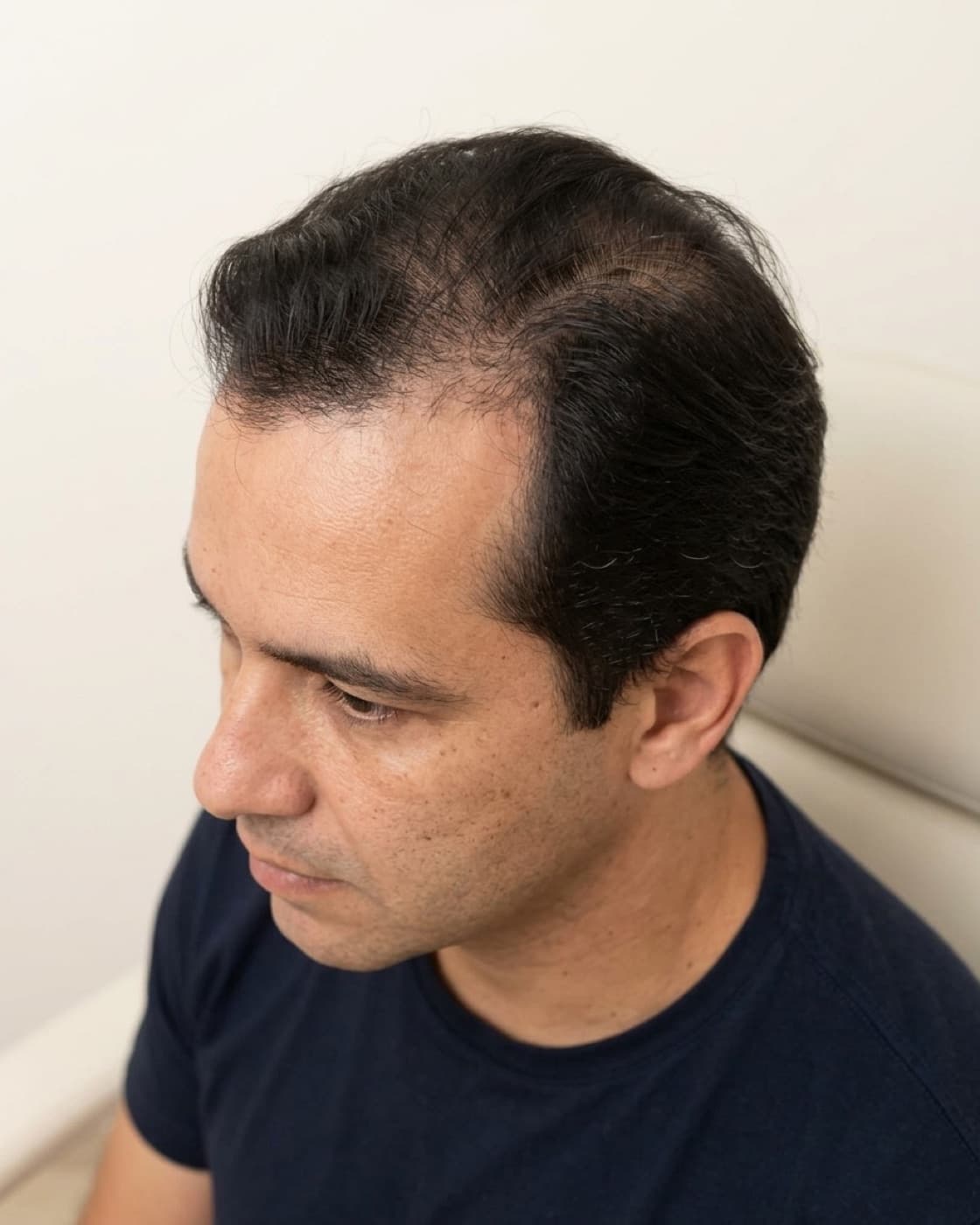
Why it happens
In androgenetic alopecia, the follicles in some areas of the scalp are genetically sensitive to dihydrotestosterone (DHT), a derivative of testosterone present in men and women. Under its action, the hair growth phase becomes shorter, and hairs grow increasingly finer, shorter and lighter, a process called miniaturization. Over time, the follicle may stop producing hair.
In men, the typical pattern starts at the temples and the top of the head. In women, thinning is diffuse on the top, with a wider part.
How the evaluation is done
The dermatologist assesses the pattern of thinning, family history and signs of hormonal changes, performs digital trichoscopy, which shows the variation in hair thickness, and orders blood tests to rule out associated causes.
Recommended treatments
The basis of treatment is the oral and topical medications prescribed at the appointment. In-office procedures enhance the result.
- Digital trichoscopyConfirms miniaturization and monitors the response to treatment.
- Hair MMPMedication delivered to thinning areas, as a complement.
- Hair mesotherapyMicro-injections of active ingredients into the scalp.
- Scalp microneedlingScalp stimulation and absorption of active ingredients.
- Capellux®Hair LED therapy as a complement.
Combined treatments
Combining medications with hair MMP, mesotherapy, microneedling and LED therapy acts on more than one aspect of hair loss, according to the indication. Trichoscopy is repeated during follow-up to compare density.
All procedures are recommended and performed after an individual medical evaluation. Results vary from person to person.
Questions
Frequently asked questions
Do women also get pattern baldness?
Yes. In women, androgenetic alopecia usually causes diffuse thinning on the top of the head, with a wider part, while preserving the hairline.
Can pattern baldness be cured?
Pattern baldness cannot be cured, but it can be controlled. Ongoing treatment reduces progression and, in many cases, recovers part of the thickness and density of the hair.
When should I start treatment?
As soon as possible. Treatment works best while the follicles are still active; once a follicle stops producing hair, recovery is limited.
Is a hair transplant an option?
Yes, in selected cases, for areas with low density. A transplant does not stop the progression of baldness, and medical treatment remains necessary.
Team
Medical team
See also