
04 · Non-surgical skin tightening and contouring
Ultraformer® MPT: microfocused ultrasound for skin laxity
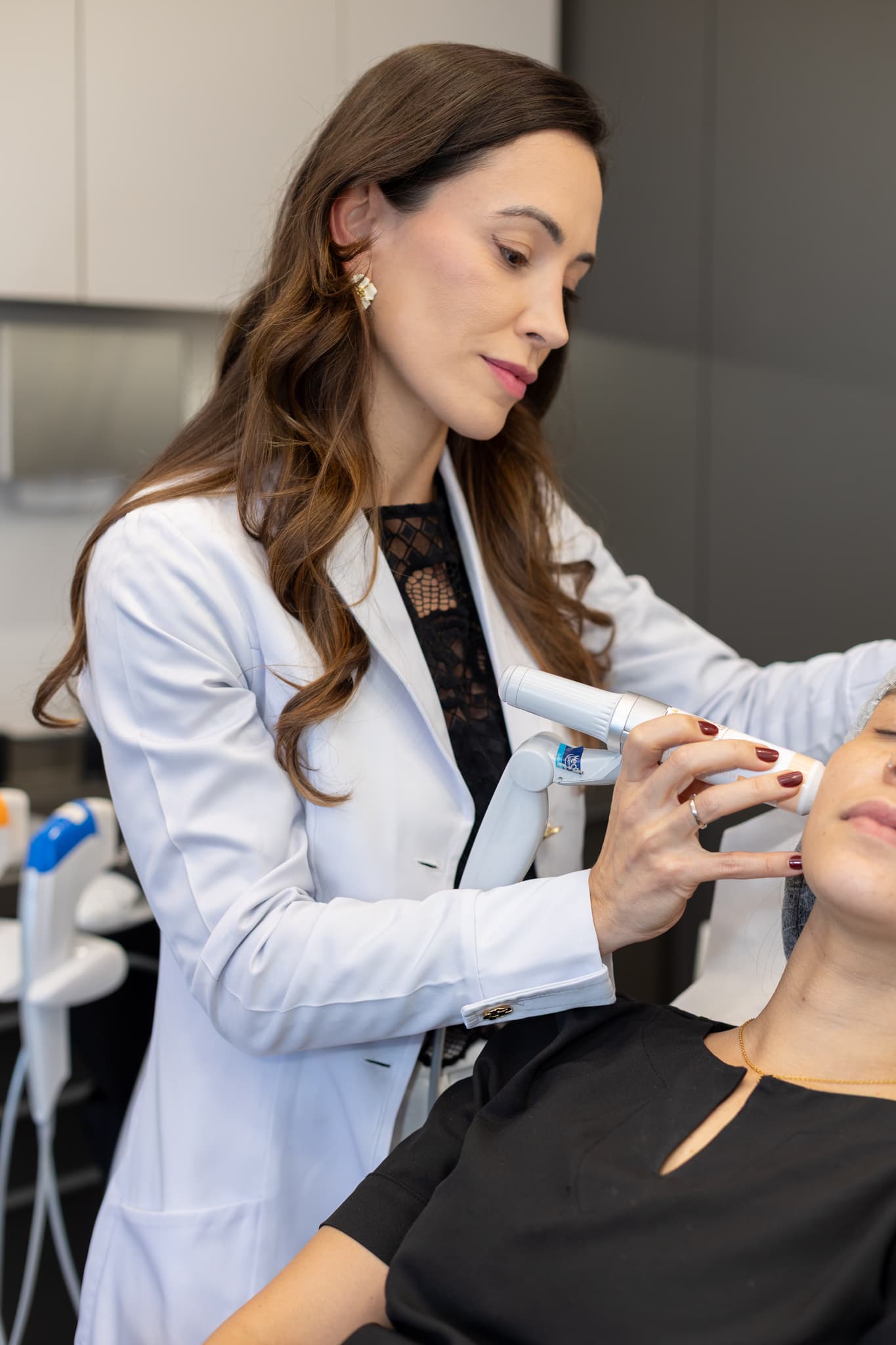
Ultraformer® MPT is a microfocused ultrasound (HIFU) device that concentrates heat at precise points in the deep layers of the skin, without incisions or needles. This heating contracts the supporting fibers and stimulates collagen production, improving skin laxity on the face, neck and body and reducing small pockets of localized fat. At Yamagata Dermatologia, in Ipanema, Rio de Janeiro, it is performed by dermatologists after a medical evaluation.
- Duration
- 60 to 90 minutes, depending on the area
- Anesthesia
- Topical anesthetic 30 minutes before
- Recovery
- Immediate return to activities
- Result
- Gradual, over 2 to 3 months
How it works
Microfocused ultrasound concentrates energy at millimetric points below the surface of the skin, much like a magnifying glass concentrates sunlight. At these points, the temperature reaches about 60 to 70 °C and creates small areas of thermal coagulation (controlled heating of the tissue), while the surface of the skin is preserved.
The body responds to this stimulus in two ways: an initial contraction of existing collagen fibers and, over the following months, the production of new collagen, which makes the skin firmer and more attached to the layers beneath.
The device uses handpieces (transducers) that reach different depths, chosen according to the area and the goal:
- SMAS (superficial musculoaponeurotic system), the supporting layer of the face, about 4.5 mm deep. It is the same layer that is lifted in a surgical facelift.
- Dermis, between 1.5 and 3 mm, for skin firmness and texture.
- Subcutaneous fat, with the deeper body transducers, to reduce small pockets of localized fat.
MPT (micro-pulsed technology) means the energy is delivered in sequences of smaller pulses, which makes the application faster. The clinic has 1.5, 2, 3 and 4.5 mm transducers, used on the face and neck, and 6, 9 and 13 mm transducers, used on the body.
Indications
Ultraformer® is indicated for mild to moderate laxity, for people who want to improve firmness and contour without surgery. In cases of marked laxity with a large excess of skin, plastic surgery tends to be more appropriate.
- Facial skin laxityLoss of facial firmness, with sagging cheeks and contour.
- Facial contour and double chinLoss of jawline definition and fat under the chin.
- Eyelids and tired lookMild laxity of the upper eyelid and the area around the eyes.
- Neck and décolletageLaxity and lines of the neck and décolletage.
- Body skin laxityLess firm skin on the arms, abdomen and flanks.
- Localized fatSmall pockets of fat on the abdomen, flanks and pre-axillary area.
Treated areas
FaceUpper face (forehead and eyebrows) · Eyelids · Cheeks (facial slimming, with an effect similar to buccal fat removal) · Perioral area (around the mouth) · Jawline · Double chin · Festoons (bags on the upper cheeks) · Full face
Neck and décolletageNeck · Décolletage
BodyPre-axillary area (between the armpit and chest) · Arms · Abdomen · Flanks · Banana roll (fold below the buttocks) · Hands
What a session is like
For greater comfort, a topical anesthetic (cream) is applied 30 minutes before the procedure. The skin is then cleaned, the areas are marked, and the doctor applies a gel and glides the handpiece over the skin in parallel lines, with pulses lasting fractions of a second. A session lasts, on average, 60 to 90 minutes, depending on the treated areas.
During the pulses, it is common to feel points of heat and slight twinges, more intense over bony areas such as the jawline and forehead, and the power is adjusted throughout the session.
Recovery
There is no downtime: you can return to work and your usual activities right after the session. In the following hours, the skin may be slightly red, and some people notice mild swelling or tenderness to the touch, which usually disappears within a few days.
Sessions and results
The number of sessions and the interval between them depend on the dermatologist's individual evaluation and on each patient's clinical concern.
Some firmness may be noticed right after the session, from the contraction of existing fibers, but the main result depends on the production of new collagen and appears gradually, over two to three months, developing for up to about six months. Because skin aging continues, maintenance sessions are usually recommended, at a frequency defined by the dermatologist. The response varies from person to person, according to age, degree of laxity, skin quality and lifestyle.
Contraindications
Ultraformer® is not recommended during pregnancy, over wounds, infections or active skin inflammation in the area to be treated, or over metal implants or electronic devices, such as pacemakers, in the region. Active autoimmune diseases, bleeding disorders and the use of some medications require case-by-case evaluation.
At the evaluation, the dermatologist reviews your health history, current medications and previous procedures to confirm the indication.
All procedures are recommended and performed after an individual medical evaluation. Results vary from person to person.
Questions
Frequently asked questions
Does Ultraformer® hurt?
The sensation varies with the area and each person's sensitivity. In general, you feel points of heat and slight twinges during the pulses, more intense over bony areas such as the jawline and forehead. For greater comfort, a topical anesthetic is applied 30 minutes before, and the power is adjusted throughout the session.
How long does it take to see Ultraformer® results?
Some firmness may be noticed right after the session, but the main result appears gradually, over two to three months, as the body produces new collagen, and continues to develop for up to about six months. The response varies from person to person.
Does Ultraformer® replace a surgical facelift?
No. Ultraformer® improves mild to moderate laxity without incisions, but it does not remove excess skin. In cases of marked laxity, plastic surgery tends to be more appropriate, and the medical evaluation helps define the indication.
What is the difference between Ultraformer® and radiofrequency?
Ultraformer® uses microfocused ultrasound, which concentrates heat at precise points and reaches deep layers such as the SMAS. Radiofrequency, such as Evolla®, heats the skin more diffusely through electrical current. The two technologies can be used separately or together, depending on the evaluation.
Does Ultraformer® help with weight loss?
No. On the body and double chin, Ultraformer® reduces small pockets of localized fat, but it does not lead to weight loss. It is indicated for people close to their usual weight who want to improve the contour and firmness of specific areas.
Can I have Ultraformer® in the summer?
Yes. Because the surface of the skin is preserved, the treatment can be done at any time of year, as long as you keep using sunscreen daily.
Team
Medical team
See also
Related treatments
Non-surgical skin tightening and contouring
Evolla® MP
Monopolar radiofrequency for firmness and contour.
Learn moreNon-surgical skin tightening and contouring
Evolla® XL
Microneedling radiofrequency that stimulates collagen.
Learn moreBiostimulators and biorevitalization
Collagen biostimulators
Gradual gain in firmness and support.
Learn moreNon-surgical skin tightening and contouring
PDO threads
Absorbable smooth and lifting threads.
Learn moreBiostimulators and biorevitalization
Harmonyca (hyaluronic acid and calcium hydroxylapatite)
Hyaluronic acid and calcium hydroxylapatite for support and volume.
Learn moreBotulinum toxin
Botulinum toxin
Forehead, frown lines, masseter, gummy smile, neck and trapezius.
Learn more